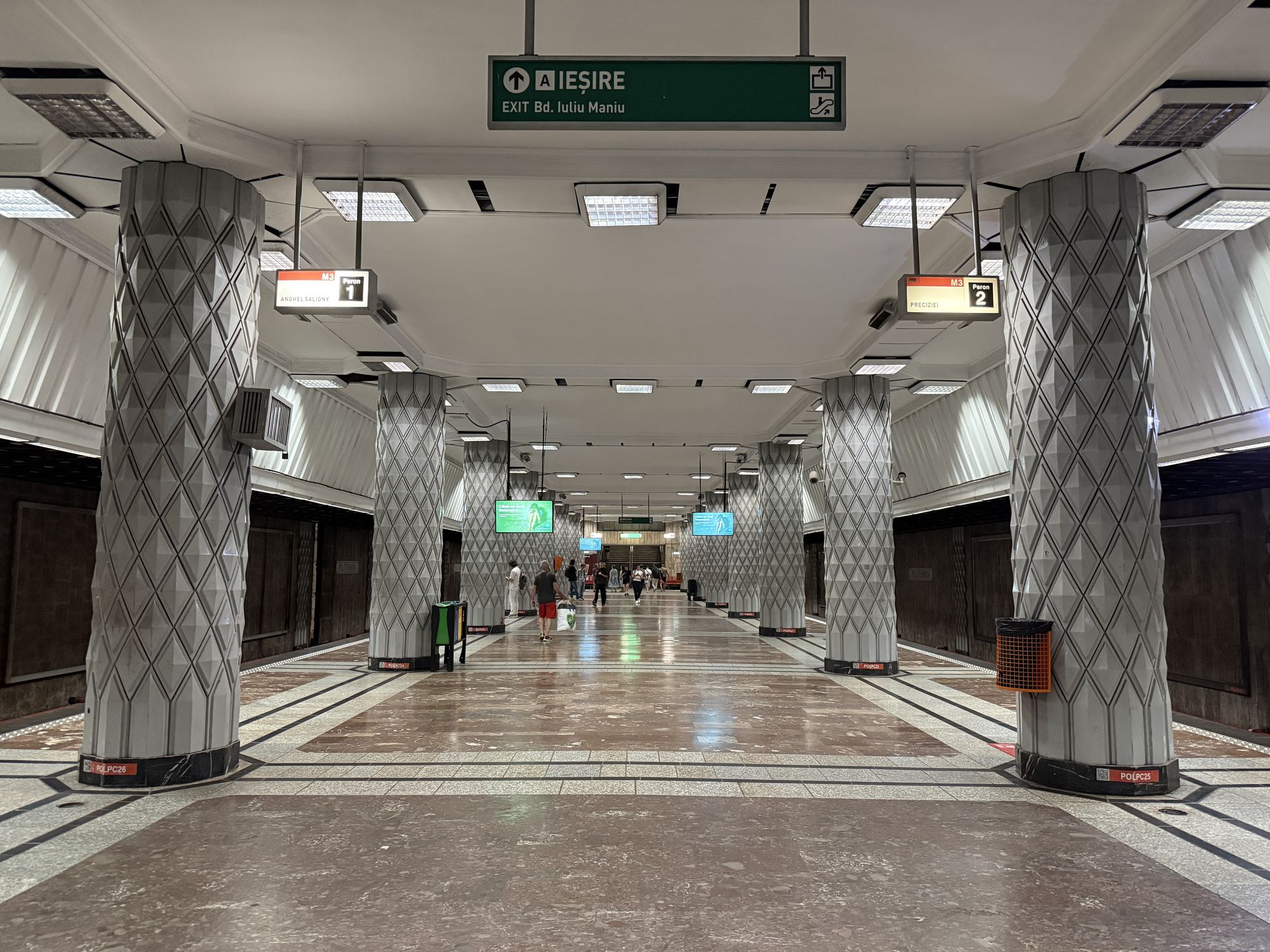
The Politehnica station on Metro Line 1 is part of the Bucharest Metro, which opened in 1979 as the first underground railway in Romania and one of the later metro systems built in the communist bloc. The system was a major prestige project of the Ceausescu regime, built partly to showcase Romanian technical capability and partly to solve the growing transport problem of a city whose population was expanding rapidly under forced industrialisation.
The Bucharest Metro stations were designed with more attention to visual character than the basic functionality that defined many communist-era infrastructure projects. Politehnica — named for the nearby Technical University of Bucharest — has the distinctive aesthetic of the system: curved concrete vaults, geometric tile patterns, and the kind of spatial generosity that underground architecture sometimes achieves when it is built without the cost pressures that shape surface construction. Descending into these stations is to enter a world that was designed to impress, and which still does, if differently than its designers intended.