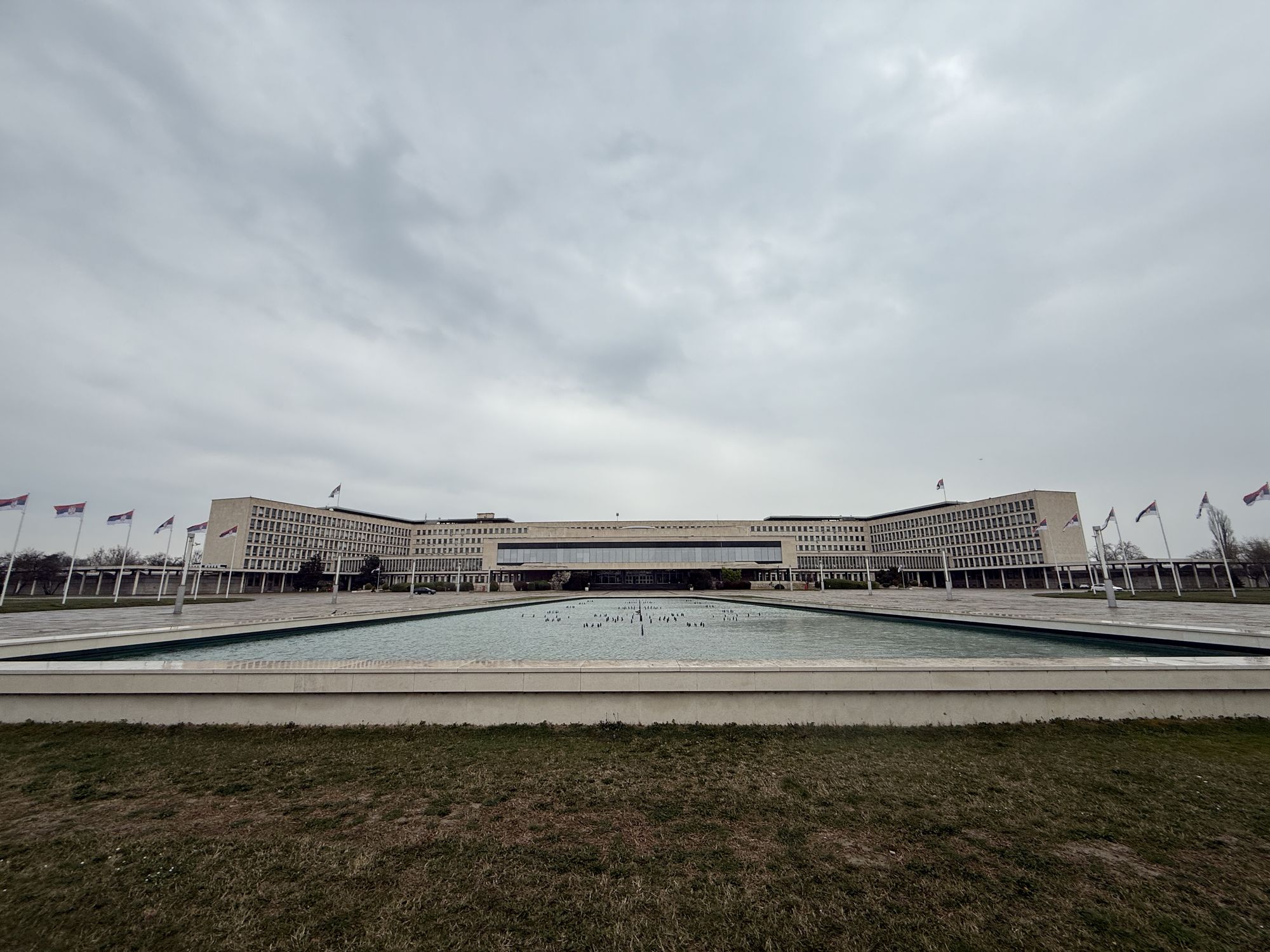
The Palace of Serbia in New Belgrade is one of the most important state buildings of postwar Yugoslavia — a massive governmental complex housing federal ministries and state organs, built on the emerging territory of New Belgrade at the moment when that city was being invented. Completed in 1961, the building sits at the junction of several major axes in the New Belgrade grid, commanding the surrounding flat landscape with a horizontal mass of stone and glass.
The architecture sits at the intersection of socialist classicism and early modernism: the scale and symmetry of the former, the materials and fenestration of the latter. It is a building that needed to project authority and permanence, and it does so — the stone cladding, the long horizontal lines, the monumental proportions all speak of a state that had decided to build for centuries. The Yugoslavia that commissioned it is gone; the building remains.