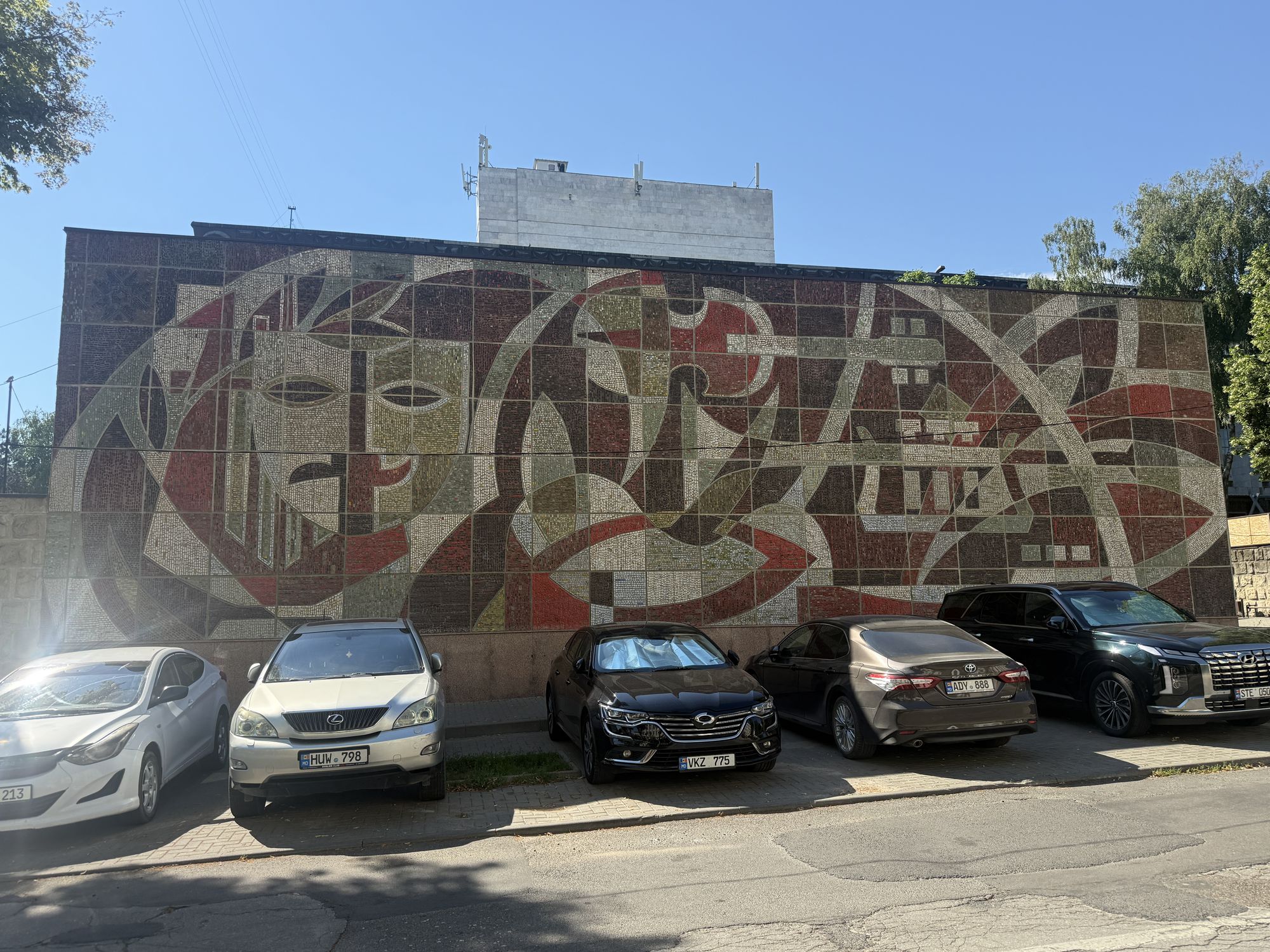
The Soviet Union produced more public mosaic art than any state in history. Between the 1960s and the collapse of the USSR in 1991, tens of thousands of monumental mosaics were installed across the Soviet republics — on the facades of factories, sports halls, bus stations, universities, and apartment blocks. Chișinău, as the capital of the Moldavian SSR, received its full share. Several dozen major works survive in the city today, in varying states of preservation.
The mosaics documented here represent two distinct traditions. The outdoor building mosaics — executed in smalt (coloured glass) and ceramic tile — typically depicted subjects drawn from Moldovan folk culture, agricultural abundance, and socialist labour: workers, harvests, mothers, cosmonauts. The interior mosaic at the Central Bus Station is a different proposition: a large-scale interior fresco in a public waiting space, intended to be read at length by passengers, its circular motifs and human figures drawn from the whole vocabulary of Soviet modernist public art. Both traditions understood something that has since been forgotten: that functional public space deserves ambitious art, and that art in transit spaces transforms the experience of movement.