Moldova takes fewer visitors than almost anywhere else in Europe, and the advice you get before going is unusually consistent: poor, quiet, not much to see. That reputation is precisely the reason to go.
A very small airport
The flight from Bucharest is shorter than some commutes. Chișinău's airport is small enough that the entire arrivals hall would fit comfortably inside a mid-sized railway station somewhere else, and because there simply are not many flights, immigration takes minutes. That smallness does not read as poverty so much as a place that has not yet been rebuilt around mass tourism.
Half an hour on a bus puts you in the centre, where a triumphal arch is the first thing to meet you — 1840, neoclassical, and modest in a way the one in Bucharest very deliberately is not.
The concrete object on the edge of town
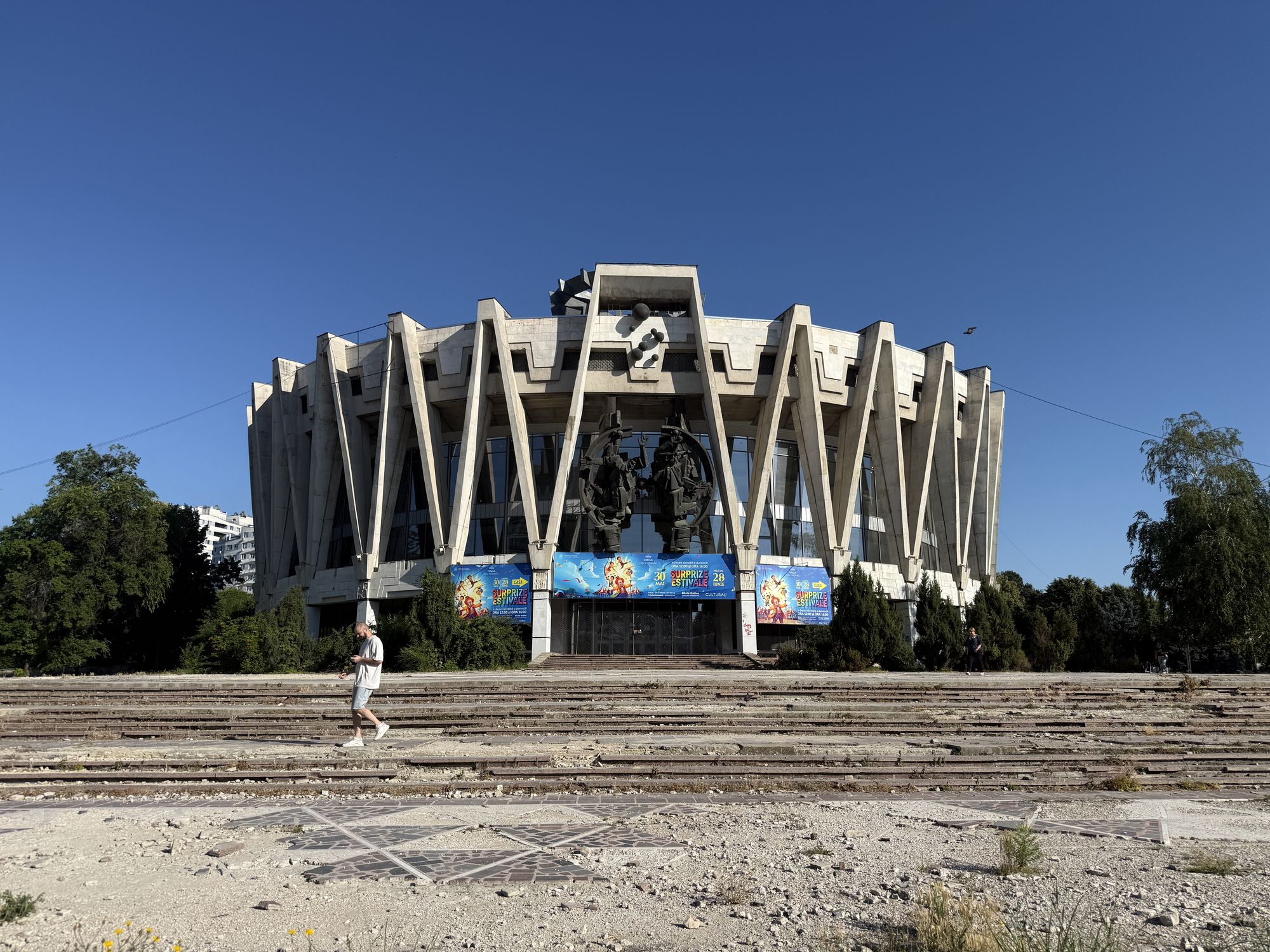
If the city allowed one photograph only, it would be the State Circus. Completed in 1981 to a design by Semyon Fridlin, it is a circular mass ringed with angled concrete ribs that taper as they climb, and from a distance it reads as something that landed rather than something that was built.
It has been out of use for years and the deterioration is visible. A building raised to entertain the public has ended up as a silent monument to the state that raised it.
What is actually disappearing
The buildings are not the fragile thing here. The mosaics are.
They are on the flanks of bus shelters, across factory frontages, in ministry entrance halls, in the waiting room at the railway station — public art from a period that believed art belonged where people walked every day, assembled one coloured tile at a time. The politics that paid for them has been gone for thirty years and almost nobody maintains them. Some have faded. Some are shedding tiles. Some have gone behind advertising boards or new insulation cladding, which is a quieter way of disappearing.
In December 2023, after campaigning by the Mosaics of Moldova project, the city agreed to add twenty-two panels to its register of public monuments. Twenty-two is a real achievement. It is also not most of them.
摩爾多瓦是全歐洲遊客最少的國家之一,而出發前你聽到的說法通常高度一致:很窮、很悶、沒什麼好看。但這個名聲本身,正是值得去的理由。
小得可愛的機場
從布加勒斯特飛過來,航程比有些人的通勤還短。基希訥烏的機場小到整個入境大堂大概只有別處一座中型火車站那麼大;而且班次本來就不多,過關只花幾分鐘。那份「小」不像寒酸,比較像是一個還沒有被大量觀光客改造過的地方,仍然按著自己的節奏在走。
搭巴士約半小時進市區,第一個迎接你的是一座凱旋門——1840 年的新古典主義小拱門,低調得剛好和布加勒斯特那座刻意的張揚形成對照。
城市邊緣那個混凝土物件
如果這座城市只准拍一張照片,那一定是國家馬戲團。1981 年落成,出自建築師 Semyon Fridlin 之手:巨大的圓形量體,外圈是一道道往上收束的斜肋,遠看不像被蓋起來的,倒像是降落在那裡的。
它已經停用多年,劣化的痕跡清清楚楚。一座為了娛樂人民而建的殿堂,最後成了那個政權自己的沉默紀念碑。
真正正在消失的東西
這裡最脆弱的不是建築,是馬賽克。
它們在公車亭的側牆上、工廠的立面上、機關大樓的門廳裡、火車站的候車室內——那是一個相信藝術該屬於所有人、該出現在人們每天路過之處的年代的產物,一小片一小片彩色瓷磚拼起來的。當年出錢的政權已經消失三十年,現在幾乎沒有人維護它們。有的褪色,有的正在剝落,有的則消失在廣告看板或新做的外牆保溫層後面——那是一種比較安靜的消失方式。
2023 年 12 月,在 Mosaics of Moldova 這個公民計畫推動下,市政府同意把二十二幅壁畫列入公共紀念物登錄。二十二是實實在在的成果,但那並不是它們的大部分。
Practical guide — 2026
Conditions here change with politics. Check current advice before you travel; this reflects a June 2026 visit and sources current at that time.
Arriving
Low-cost carriers fly in from Bucharest and other European cities. The airport is small and immigration is quick; a bus takes about half an hour into the centre.
Getting around
The centre is walkable. Trolleybuses and marshrutkas cover the rest, and are cheap. The mosaics are scattered across the whole city, so it pays to plan a route rather than wander.
Finding the mosaics
Many are on buildings still in daily use — bus stops, offices, the station. Photographing them from the street is unremarkable; if a panel is inside a lobby, ask first.
How long
Two days on foot covers the centre and most of the surviving mosaics. Moldova is not a place you need to rush.