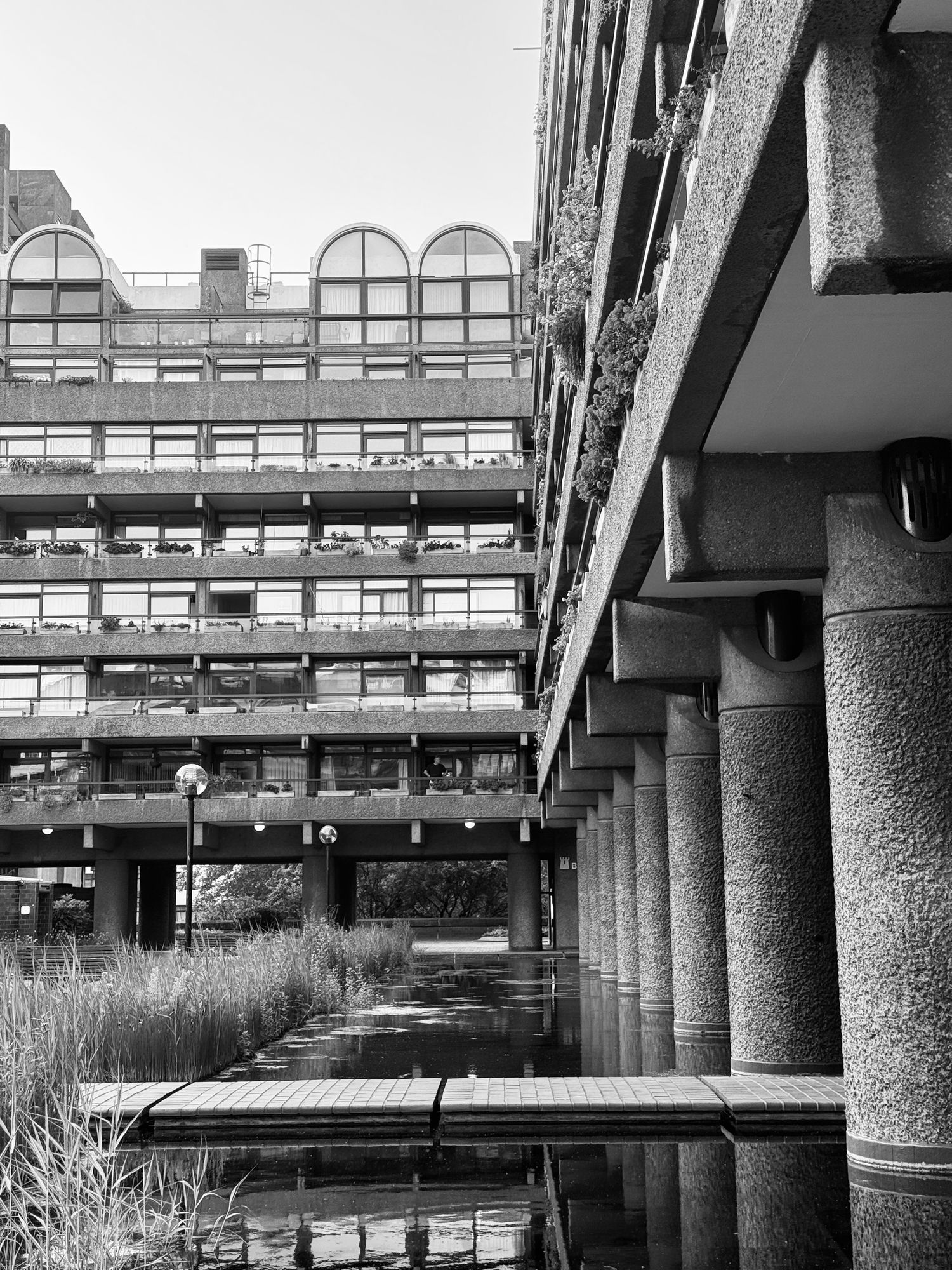
The Barbican is the largest brutalist complex in Europe — a self-contained residential city of 2,000 flats, a concert hall, two theatres, three cinemas, two art galleries, a conservatory, a school, and an ornamental lake. Designed by Chamberlin, Powell & Bon and built between 1965 and 1982, it was conceived as a response to the devastation of the Blitz: a complete urban neighbourhood built from scratch on bombed-out ground in the City of London.
The architecture is relentlessly consistent — bush-hammered concrete used everywhere, the same aggregate, the same texture, the same colour. The raised walkways, the water terraces, the cylindrical towers, the dense interlocking of residential and cultural functions — all of it was meant to demonstrate that density and urban life were not incompatible. After decades of critical neglect, the Barbican is now Grade II listed and one of the most sought-after addresses in London.