Almost nobody arrives in Bucharest with a picture of it already in their head. Belgrade and Berlin have been photographed into the imagination; Bucharest has not. It turns out to be an advantage — the city gets to surprise you.
The building you cannot walk around
Arcul de Triumf comes first: granite, squarely built, covered in reliefs, raised for the dead of the First World War and openly modelled on the Paris arch. It is the plainest surviving statement of this city's old nickname and its old ambition.
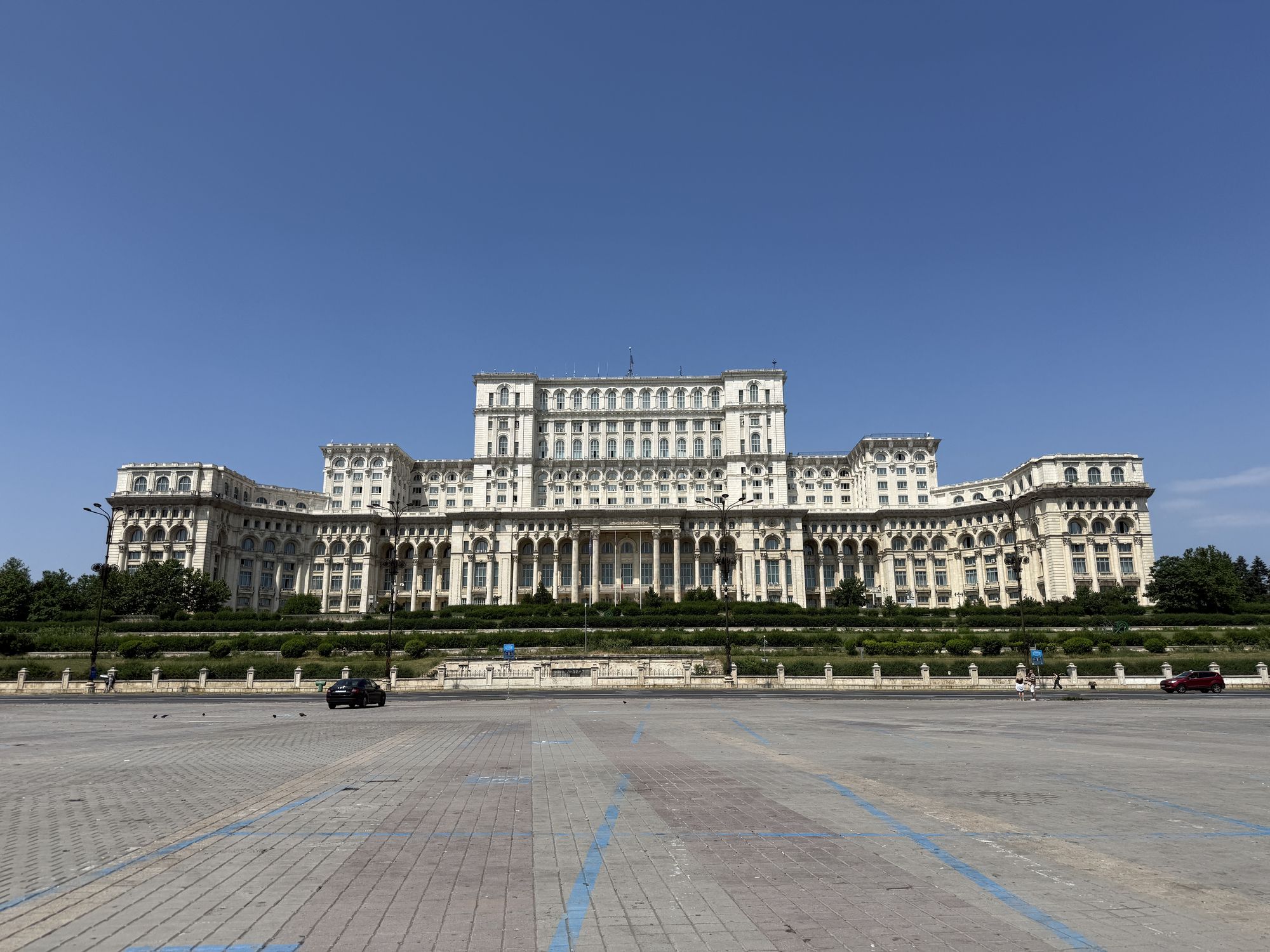
Then there is the Palace of the Parliament, which you do not need to go inside to understand. It is the heaviest building on earth and the largest administrative building after the Pentagon, with over a thousand rooms, built using something close to Romania's entire marble output, on ground cleared by demolishing a large part of the historic city. It is too big, too white, too symmetrical — the proportions are designed to make whoever stands in front of them smaller. Walking its perimeter takes longer than feels reasonable, and somewhere in that walk the scale stops being a statistic.
Obor, where nobody is photographing
The monuments were built to be looked at. What I wanted to see was the ordinary version, so I went out to Obor, a district that appears on no tourist map.
The atmosphere changes immediately. There are no cameras. There are rows of unrenovated socialist blocks in grey precast panel, balconies loaded with washing lines, satellite dishes, pot plants and stored furniture, decades of water staining down the facades. These blocks were the ideology made literal: thousands of households filed into a single geometric order. The order did not survive. The buildings did, and they are full — the cold blueprint has been kneaded back into something with a temperature. The old trams that run between them are worth riding for their own sake.
The other Bucharest
Lipscani, the old town, is a different city again. Cărturești Carusel is a nineteenth-century building that stood derelict and is now a bookshop: six floors of slender white balustrades spiralling around an open void, daylight dropping from a rooflight onto white walls. After a day of grey concrete it works as a kind of rest for the eyes.
A few streets away, Stavropoleos Monastery is small enough to walk straight past — 1724, in the Brâncovenesc style particular to Romania, with a deeply carved stone porch and a planted courtyard. It sits one wall away from a street of loud restaurants and does not appear to have noticed them.
幾乎沒有人是帶著既定畫面來到布加勒斯特的。貝爾格勒和柏林早就被拍進大家的想像裡,布加勒斯特沒有。而這反而成了優勢——這座城市還有機會讓你意外。
那棟你繞不完的建築
先是凱旋門:花崗岩、方正厚重、佈滿浮雕,為一戰陣亡將士而建,明擺著以巴黎那座為藍本。它是這座城市舊日綽號與舊日野心最直白的一份存留證明。
然後是人民宮,你不需要走進去也能明白它。它是地球上最重的建築、僅次於五角大廈的最大行政建築,一千多個房間,用掉了接近羅馬尼亞全國的大理石產量,而它腳下的地,是拆掉大片歷史城區換來的。它太大、太白、太對稱——那個比例本身就是設計來讓站在它面前的人變小的。沿著外圍走一圈,久得超出常理,而就在那段路的某一刻,尺度不再只是一個數字。
Obor:沒有人在拍照的地方
紀念碑是蓋來被觀看的。我想看的是日常的那個版本,所以去了Obor——一個不會出現在任何觀光地圖上的老城區。
氣氛立刻就變了。這裡沒有相機,只有一排排未經翻修的社會主義住宅樓:灰色預製混凝土板,陽台上掛滿曬衣繩、衛星天線、盆栽和堆放的舊傢俬,牆面上是幾十年累積的水痕。這些樓是意識形態最具體的肉身:把成千上萬個家庭,收進同一套幾何秩序裡。秩序沒有留下來,樓留下來了,而且住滿了人——當年那份冰冷的藍圖,已經被揉回成有溫度的東西。穿行其間的舊電車,光是搭一趟就值得。
另一個布加勒斯特
舊城 Lipscani 又是另一座城市。Cărturești Carusel 原本是一棟十九世紀的老建築,一度荒廢,如今是書店:六層挑空,纖細的白色欄杆一圈圈盤旋而上,天光從頂上的天窗落到白牆上。看了一整天灰色混凝土之後,這片白幾乎像是給眼睛的休息。
幾條街外的斯塔弗羅波萊奧斯修道院小得會被走過頭——1724 年,羅馬尼亞獨有的布倫科維努式,石雕門廊層次繁複,內院種著花。它和隔壁那條人聲鼎沸的餐廳街只隔一道牆,卻像完全沒有注意到它們。
Practical guide — 2026
Conditions here change with politics. Check current advice before you travel; this reflects a June 2026 visit and sources current at that time.
Getting around
The metro plus the tram network reaches everything here, including Obor. Trams are the better choice for looking out of the window.
The Palace
The exterior is the experience, and it is free. Guided tours of the interior are run but generally need booking in advance and photo ID — check the current arrangement before you count on getting in.
Obor
This is a lived-in residential district, not a sight. Photograph the buildings and the street, keep your distance from people's windows and balconies, and it is entirely unremarkable to be there.
How long
Three days is comfortable: one for the monumental core, one for the ordinary districts, one for the old town.