I flew into Warsaw late from Chișinău and took a car into the centre, and the first thing I noticed about Poland was the road surface. It was flat. Coming straight from Moldova, where my body had spent two hours learning every joint in the concrete, that was not a small observation.
A city rebuilt from paintings
Plac Zamkowy in the morning: Sigismund's Column, the red brick of the royal castle behind it, the square opening out. Further in, the market square is enclosed by coloured gable houses with restaurant umbrellas underneath them.
All of it was rubble in 1945. The old town was put back deliberately, using old paintings and drawings as the reference. The stubbornness in that decision is more impressive than any single building it produced.
The monument that is still moving
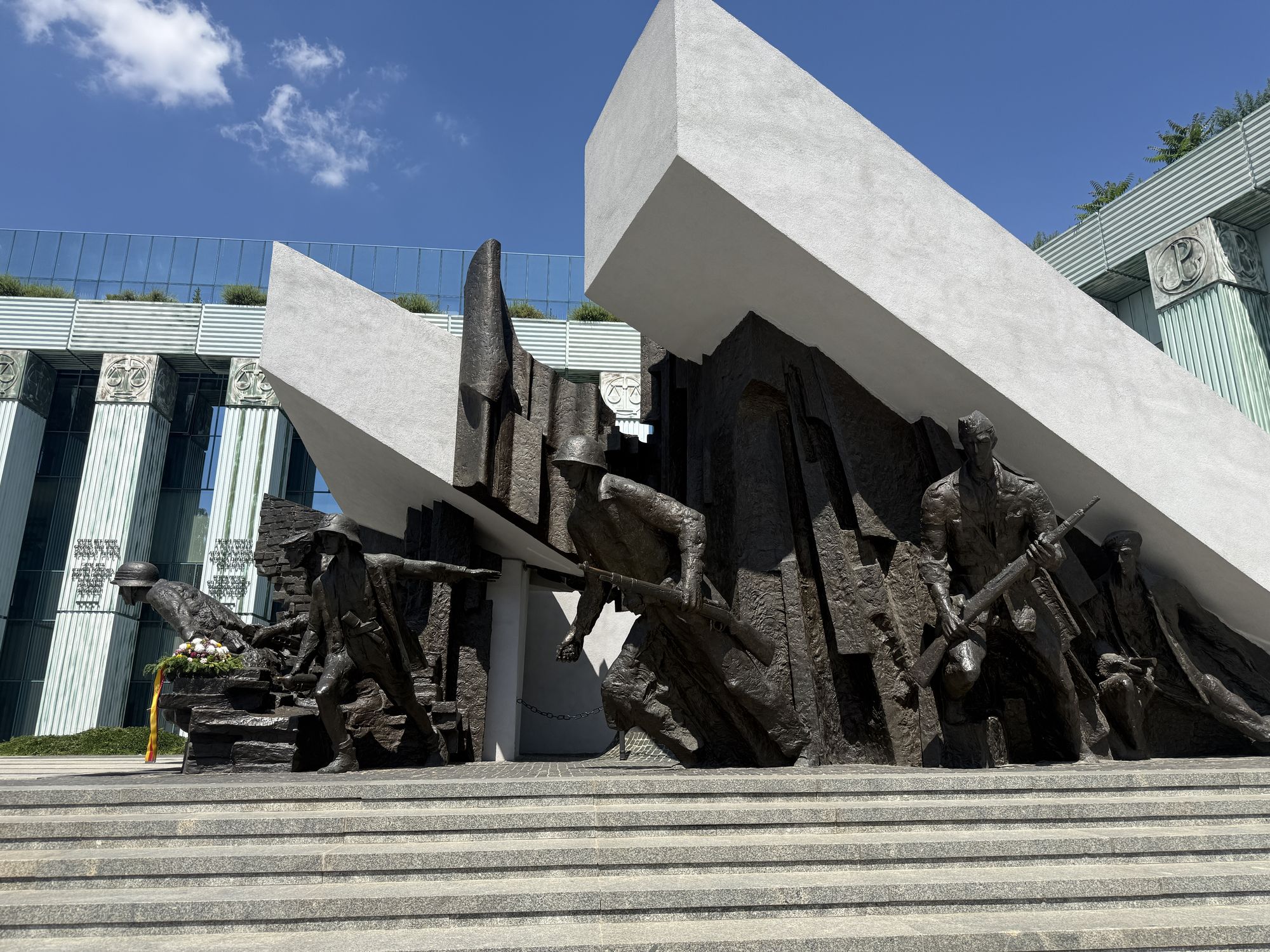
The Warsaw Uprising Monument is the one that stayed with me. Bronze insurgents break out from beneath a heavy concrete slab — mid-run, mid-jump, covering one another — motion frozen at its loudest point. The bronze columns of the Supreme Court stand immediately beside it, and the two together make the most forceful street corner in the city.
The Uprising Museum takes hours rather than minutes. The wall of names, and the anchor-shaped symbol of Fighting Poland, do not let go quickly.
Four hours in first class
The train to Wrocław deserves its own paragraph. Clean, quiet, seats with genuine space; four hours passed very comfortably, with flat country and small towns going past the window. What a country does with its railways says a good deal about it.
Wrocław got one day. The Rynek is the city's living room, with the old town hall and its astronomical clock in the middle and the Hala Targowa nearby — a working market under concrete arches. And then there are the dwarfs. Several hundred small bronze krasnale are hidden around the city, pushing carts, sleeping, playing instruments, and finding them becomes compulsive very quickly. Their origin is not whimsical: they descend from the Orange Alternative, the movement that answered an absurd system in the 1980s with deliberate absurdity of its own.
Walking those two cities, I noticed that I had stopped watching my back, and had stopped thinking about where my phone was. That is a comparison I can only make from my own feet, having walked plenty of larger cities where I do think about it.
我從基希訥烏搭晚班機飛到華沙,再搭車進市區,而我對波蘭的第一個印象是路面。它很平。剛從摩爾多瓦過來——我的身體才花了兩個小時認識那條路上的每一道接縫——這個觀察一點都不小。
一座照著畫重建的城市
早上的城堡廣場:齊格蒙特圓柱、後面磚紅色的皇家城堡,廣場開闊起來。再往裡走,舊城集市廣場被彩色山牆房子圍住,底下一排餐廳的遮陽傘。
這一切在 1945 年全部是瓦礫。舊城是刻意被砌回去的,依據是舊時的畫作與圖紙。那個決定裡的執拗,比它造出來的任何一棟建築都更令人震撼。
那座還在動的紀念碑
華沙起義紀念碑是留在我腦裡最久的一座。青銅鑄成的起義軍從厚重的混凝土斜板下衝出來——正在奔跑、正在躍下、正在互相掩護——動勢被凍結在最大聲的那一刻。最高法院那排青銅巨柱就在旁邊,兩者合起來構成全城最有力量的一個街角。
起義博物館需要的是幾小時而不是幾分鐘。那面刻滿姓名的牆,還有那個錨形的「戰鬥波蘭」符號,不會很快放過你。
一等座上的四小時
去弗次瓦夫的火車值得單獨寫一段。車廂乾淨、安靜,座位是真的寬敞;四個小時過得非常舒服,窗外是平坦的原野和小鎮。一個國家怎麼對待它的鐵路,其實說明了不少事。
弗次瓦夫只有一天。Rynek 是這座城市的客廳,中央是舊市政廳和它的天文鐘,旁邊是 Hala Targowa——混凝土拱肋下仍在營業的市場。然後是小矮人。全城藏著幾百個巴掌大的銅製 krasnale,有的推車、有的睡覺、有的彈琴,找它們很快就會變成戒不掉的事。它們的來歷並不童話:它們源自「橙色另類運動」——1980 年代那個用刻意的荒謬去回應荒謬體制的運動。
走在這兩座城市裡,我發現自己不再留意身後,也不再一直想著手機放在哪裡。這個比較我只能從自己的雙腳說起——我走過不少更大的城市,在那些地方我是會想的。
Practical guide — 2026
Conditions here change with politics. Check current advice before you travel; this reflects a June 2026 visit and sources current at that time.
Trains
Intercity services between Warsaw and Wrocław take around four hours and are genuinely comfortable. First class costs relatively little more than second and is worth it on this route. Book ahead for the better fares.
Warsaw on foot
The old town, the Uprising Monument and the Supreme Court sit within an easy walk of one another. Leave several hours for the Uprising Museum if you intend to do it properly.
The dwarfs
Wrocław's krasnale run into the hundreds and are genuinely hidden — at ankle height, on ledges, beside drainpipes. Maps and apps exist if you want to be systematic; wandering works too.
How long
Two days in Warsaw and one in Wrocław fits the architecture comfortably, with the train in between as part of the trip rather than a cost of it.