Transnistria declared itself independent from Moldova in 1990 and fought a war for it in 1992. No UN member state recognises the result. It is also, from Chișinău, a two-hour minibus ride — which is how most people who go there end up going.
The minibus, and the road
Transport to Tiraspol leaves from Chișinău's central bus station, and it is not a coach. It is a marshrutka: the white twenty-seat minibus that does most of the work of moving people around the former Soviet Union. I travelled in the European heatwave of June 2026. Moldova was in the low thirties, the vehicle had no air conditioning, and two windows opened. The air inside thickened steadily for two hours.
The road did not help. Long stretches of the route are still laid in old concrete slabs, and every joint between them arrives as a distinct knock through the seat frame. Nobody gets off, though. There is a checkpoint ahead, and for most passengers on that bus, the checkpoint is the point.
Where the alphabet changes
The first thing that changes after the crossing is the writing. Moldova's Latin script thins out and Cyrillic replaces it — shop fronts, road signs, hand-lettered notices in windows. You do not need to look at the stamp in your passport to know you have moved between two administrations. The street tells you.
One name, over everything
Then a single word starts repeating. Sheriff. The petrol station is Sheriff. The supermarket is Sheriff. The stadium — visible long before you reach it — is Sheriff.
Sheriff Holding was founded in the early 1990s by men who came out of the security and law-enforcement services, and it has since grown into the structural frame of the local economy: retail, fuel, telecoms, television, car dealerships, a distillery, and the football club. On 28 September 2021 that club, representing a state nobody recognises, won 2–1 at the Santiago Bernabéu — Yakhshiboev opening the scoring, Benzema equalising from the spot, Sébastien Thill settling it in the 89th minute. It remains one of the great Champions League upsets. Here, the line between what is public and what is private is drawn differently than you may be used to.
Lenin is not hidden here
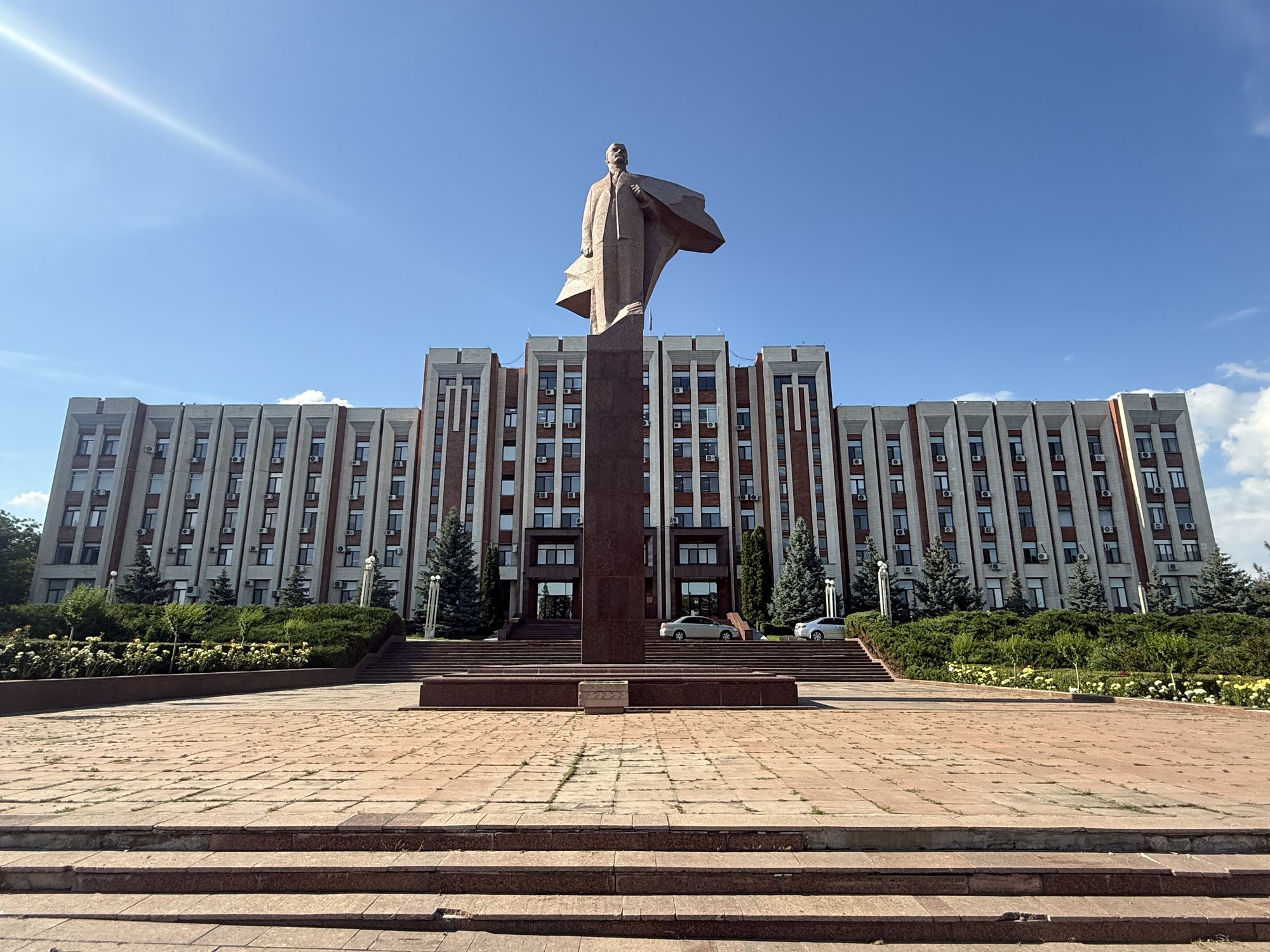
Walk into the centre and the statues find you rather than the other way round. The most imposing stands in front of the Pridnestrovian Government Building: a heavy bust, brow drawn down, a rank of flags behind it. There is another at the door of Tiraspol City Hall. In most post-Soviet capitals this material has been moved to a park on the outskirts or a museum basement. In Tiraspol it is simply on the way to work.
Across the river: Bender
The republic is not only its capital. Bender sits on the far bank of the Dniester, close enough for half a day, and it reads slightly differently. Its weightiest structure is not Soviet at all: Bender Fortress is an Ottoman military work whose stonework goes back to the sixteenth century, and it is a useful corrective. The layers here did not begin stacking in 1991. Nearby, Bender train station keeps a quieter kind of time — long platforms, very few departures — and beside the power plant there is a monument where industry and ideology have again been welded into the same object.
德涅斯特河沿岸(德左)在 1990 年宣布脫離摩爾多瓦,1992 年為此打過一仗。至今沒有任何聯合國會員國承認這個結果。 但從基希訥烏出發,它只是一段兩小時的小巴車程——多數人也就是這樣去的。
小巴,以及那條路
開往提拉斯波爾的車從基希訥烏中央巴士站發車,不是遊覽車,是 marshrutka:那種在前蘇聯地區承擔大部分載客工作的白色小巴,坐得下二十人左右。 我去的時候正好碰上 2026 年 6 月席捲歐洲的熱浪。摩爾多瓦氣溫三十出頭,車上沒有冷氣,能打開的窗只有兩扇。兩個小時裡,車廂內的空氣一路變稠。
路況也不幫忙。往提拉斯波爾的公路有好幾段仍是舊式水泥板鋪面,每一道接縫都清清楚楚地從座椅底下敲上來。 但沒有人中途下車。前方有一道關卡,而對車上大部分人來說,那道關卡就是此行的目的。
字母換了的地方
過關之後最先改變的是文字。摩爾多瓦的拉丁字母逐漸稀疏,西里爾字母補了上來——店面招牌、路標、貼在窗上的手寫告示。 你不必翻護照看那個章,光看街上的字就知道自己已經跨進另一套管治秩序。
一個名字,蓋住整座城
接著會有一個詞開始不斷重複:Sheriff。加油站是 Sheriff,超市是 Sheriff,那座老遠就看得見的球場也是 Sheriff。
Sheriff Holding 成立於 1990 年代初,創辦者出身保安與執法系統,此後長成了當地經濟的骨架:零售、燃油、電訊、電視台、汽車銷售、酒廠,還有那支足球隊。 2021 年 9 月 28 日,這支代表一個無人承認之國的球隊,在伯納烏以 2:1 取勝——第 25 分鐘 Yakhshiboev 先開紀錄,賓斯馬十二碼追平,第 89 分鐘 Thill 一錘定音, 至今仍是歐冠史上最著名的冷門之一。在這裡,公與私的界線,畫的位置跟你習慣的不太一樣。
列寧不需要找
走進市中心,不是你找雕像,是雕像找你。最有份量的一尊立在 德涅斯特河沿岸政府大樓前:厚重的胸像、壓低的眉、身後一整排旗幟。 提拉斯波爾市政廳門口還有一尊。 在多數後蘇聯首都,這類東西早被搬到郊區公園或博物館地下室;在提拉斯波爾,它就在上班的路上。
過河:本德爾
德左不只有首都。本德爾在德涅斯特河對岸,近得半天就能來回,氣氛也略有不同。 這裡最厚重的建築完全不是蘇聯的:本德爾要塞是鄂圖曼時期的軍事構造,石牆可上溯至十六世紀。 它是一個有用的提醒——這片土地的層次,並不是從 1991 年才開始疊的。不遠處的 本德爾火車站走的是另一種時間:月台很長,班次極少。 發電廠旁還有一座紀念碑,工業與意識形態又一次被焊進同一個物件裡。
Practical guide — 2026
Conditions here change with politics. Check current advice before you travel; this reflects a June 2026 visit and sources current at that time.
Getting there
Marshrutka from Chișinău central bus station to Tiraspol, roughly 60 Moldovan lei and about two hours. No air conditioning — in summer this matters.
The border
No visa. You show your passport and are issued a migration card. The default is a short stay of around ten hours; say at the desk if you need longer, which generally requires a hotel booking. Keep the card — you must hand it back on the way out.
Money
Cash only in practice; foreign cards are widely refused. Exchange offices are easy to find, including inside Sheriff supermarkets. Change only what you need — Transnistrian rubles are close to impossible to convert once you leave.
What you may not photograph
Street scenes and the Lenin statues are fine. Checkpoints, military sites, soldiers, police and security personnel are not — this is enforced, and can mean questioning and confiscated equipment. Be discreet around government buildings.