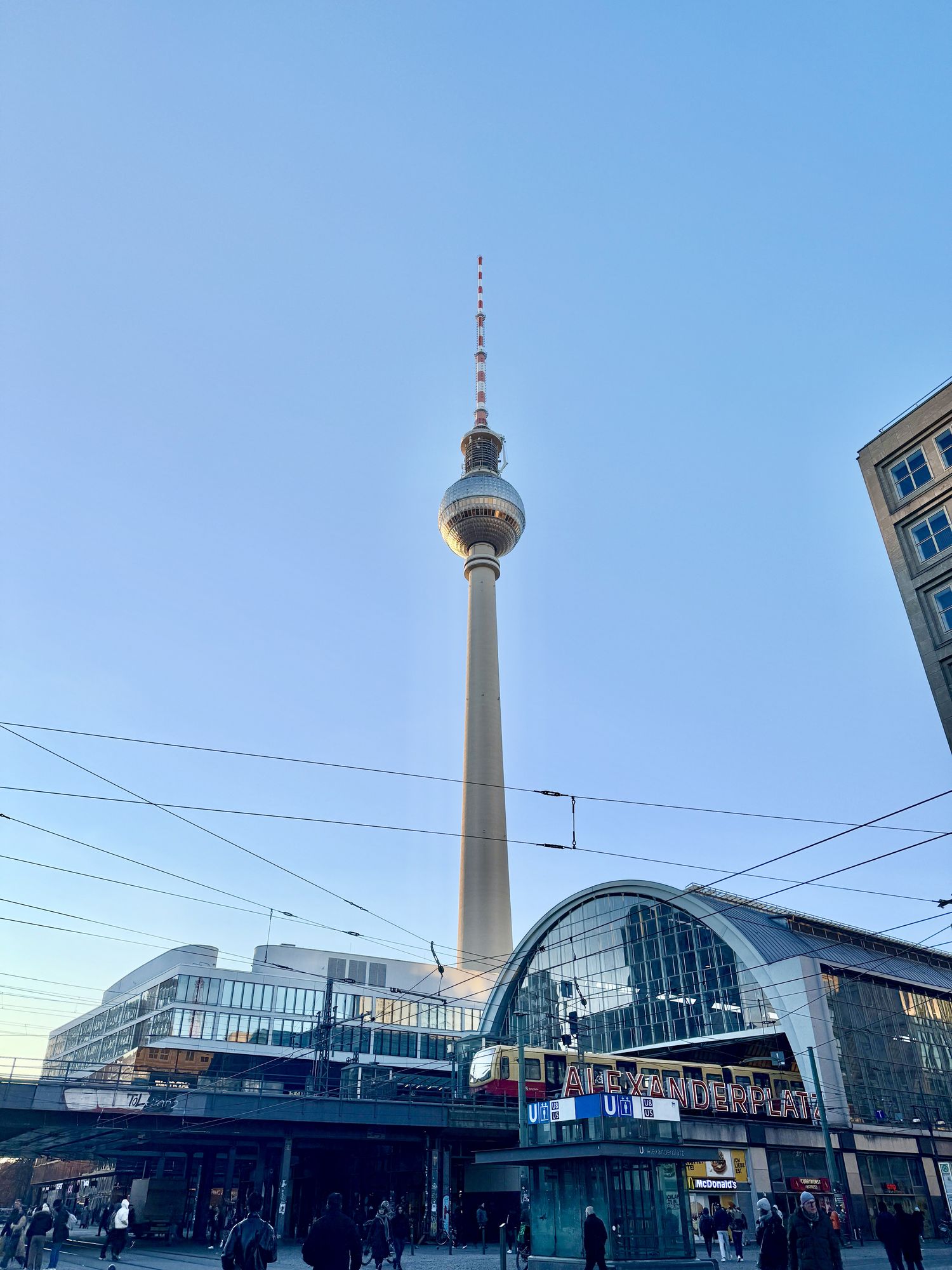
Two hours from London, and you know on landing that this is not an ordinary city. I stayed in the east, deliberately.
The avenue that is too long
Coming in on the S-Bahn, the buildings start speaking a different language — not British concrete, not the confidence of Yugoslav modernism, but something more guarded.
Karl-Marx-Allee is long in a way that is not comfortable. Stalinist blocks from the 1950s run down both sides, faced in ceramic tile, symmetrical well past the point of reassurance. This was East Germany's opening architectural argument: socialist dignity, built out of stone and render, and you can feel the weight of the period pressing on every course of it.
Café Moskau stands on the same avenue — low, horizontal, deeply canopied, with a large metal globe mounted on the front. It opened in 1964 as a symbol of Soviet–German friendship and is now a club and event space. The globe is still up there, rusted a little, still behaving as though it owns the sky.
Following the line
The Wall came down in November 1989 and most of it was absorbed into the city within a few years. The line did not go anywhere. Sometimes it is a double row of bricks set into the road, sometimes an information panel, sometimes an unexplained gap between buildings. Follow it and the city begins to read differently.
At Bernauer Strasse a section of the death strip has been kept as it was: inner wall, outer wall, and the narrow empty ground between them where people were killed. Sunlight on the grass now, children playing alongside. The gap between those two facts is hard to hold.
The Window of Remembrance is a grid of rust-coloured openings, each holding one photograph of someone who died trying to cross. Young faces, old faces, some barely out of childhood, all turned towards the city and the people still moving through it. Each one is a whole life cut off by a line drawn on a map.
The other Berlin
Kreuzberg is the counter-argument to all of that: migrants, artists, graffiti, döner, a neighbourhood grown up wild on ground that wartime bombing cleared.
St. Agnes is a concrete cube with a cylinder attached. No spire, no rose window, none of the things a church is supposed to have — rough concrete, minimal openings, as silent as someone who has decided not to explain themselves. It is the König Galerie now, and inside the weight comes off: a tall room, daylight arriving sideways and diffused, white walls, nothing asking anything of you.
Haus Spitteleck, near Spittelmarkt, is a curved commercial block in precast panel. It is ordinary, and that is exactly why it is worth stopping for: this, rather than Alexanderplatz, is what most people's daily background actually looked like.
從倫敦飛過來兩個小時,落地那一刻你就知道這不是一座普通的城市。我刻意選擇住在東柏林。
那條太長的大道
搭 S-Bahn 進城,窗外的建築開始說另一種語言——不是英式的混凝土,也不是南斯拉夫那種高度的自信,而是更防備的東西。
卡爾馬克思大道長得讓人不舒服。1950 年代的史達林式建築沿著兩側一路排開,外覆陶瓷磚,對稱到早已越過令人安心的界線。這是東德最初的建築宣言:用石材與灰泥堆砌出來的社會主義莊嚴;走在裡面,你幾乎感覺得到那個年代的重量壓在每一層砌體上。
Café Moskau 就在同一條大道上——低矮、橫向延伸、深挑的屋簷,立面上架著一顆巨大的金屬地球儀。1964 年開幕,作為蘇德友誼的象徵,如今是夜店與活動場地。地球儀還在上面,鏽了一點,仍是一副君臨天下的樣子。
沿著那條線走
圍牆在 1989 年 11 月倒下,大部分在幾年內就被城市吸收掉了。但那條線沒有消失。有時候它是路面上一道雙排的磚,有時候是一塊解說牌,有時候是兩棟建築之間一段沒有理由的空地。循著它走,整座城市會開始讀出另一種意思。
在貝爾瑙爾大街,有一段死亡地帶被原樣保留下來:內牆、外牆,以及中間那條狹長的、什麼都沒有的空地——從前就是這段空地讓人喪命。現在陽光照在草地上,旁邊有孩子在玩。這兩個事實之間的落差,很難同時握住。
記憶之窗是一整面鏽色的方形開口,每一個開口裡是一張照片,一個試圖越牆而死在那條線上的人。年輕的臉、年老的臉、有些孩子氣都還沒褪,全部朝向城市,朝向仍在流動的人群。每一張後面,都是一整個人的生命,被地圖上的一條線截斷。
另一個柏林
克羅伊茨貝格是上述一切的反面:移民、藝術家、塗鴉、土耳其烤肉,一個在戰時轟炸清空的土地上野生長出來的社區。
聖阿格尼絲教堂是一個混凝土立方體加一根圓柱。沒有尖頂、沒有玫瑰窗,沒有任何一樣你期待教堂該有的東西——粗糙的混凝土、極小的開口,沉默得像一個決定不解釋自己的人。它現在是柯尼希藝廊,而走進去之後,重量就卸下了:高挑的空間,自然光從側面漫射進來,白牆,沒有任何東西要求你什麼。
施皮特爾馬克附近的 Haus Spitteleck 是一棟弧形的商業樓,外覆預製混凝土板。它很普通,而這正是值得停下來看它的理由:這個、而不是亞歷山大廣場,才是當年大多數人日常生活真正的背景。
Practical guide — 2026
Conditions here change with politics. Check current advice before you travel; this reflects a June 2026 visit and sources current at that time.
Getting around
The U-Bahn and S-Bahn reach everything here; Karl-Marx-Allee, Alexanderplatz and Bernauer Strasse are all on the network. A day ticket covering zones A–B is enough unless you are going to the airport.
The Wall memorials
The Bernauer Strasse memorial is outdoors and free, and it is the one place where the full width of the death strip survives. Allow more time than you expect for the Window of Remembrance.
St. Agnes
The church is now a commercial gallery, so the interior is open only when an exhibition is on. Check before making the trip; the exterior is worth it either way.
Winter light
December daylight is short and flat, which suits this architecture but leaves few usable hours. Plan around roughly four in the afternoon, when it goes.